Category Archives: Uncategorized

EARTHS OF DISTANT SUNS by Michael Carroll

earths-of-distant-suns-michael-carrollHow We Find Them, Communicate With Them, and Maybe Even Travel There

All of us are mesmerized by the possibility of other Earth-like worlds out there. Is there intelligent like elsewhere? Can we go there? Can we at least communicate with them?

Author Michael Carroll has spent decades as a science journalist and even longer as an astronomical artist. In Earths of Distant Suns, he asks what we can gain from identifying these Earth analogs spread across the Universe. Based on the latest mission results, and supported by the author’s artwork, this book explores the possible lessons we may learn from exoplanets. Potentially, for example, we could learn more about our own climate. Also explored are the possibilities of communication between, or even travel to, these distant yet perhaps not so dissimilar worlds.

As the number of known Earth-like objects continues to grow, the author takes us closer to these ‘pale blue dots’ so far afield. Recent discoveries by space telescopes such as Keck, the Hubble and Kepler, as well as more sensitive ground observatories, are laid out. These findings have fired the imaginations of the general public as well as scientists. Speculation about alien worlds is no longer left to the realm of science fiction!

You can purchase a copy of the book by CLICKING HERE

Leave a Comment

Filed under Uncategorized

THE MILKY WAY

astronomer-gazing-at-the-milky-wayThe Milky Way is visible as a faint pearly band of light arching across the night sky and is created by the combined glow of stars scattered along the plane of our Galaxy’s disc as seen from Earth. Deriving its name from its ‘milky’ appearance, it is easily visible to the unaided eye under clear, dark skies and any form of optical aid will show that it is made up of many thousands of individual stars producing the effect which is beautifully captured in this image.

We live in one of the arms of a large spiral galaxy we call the Milky Way Galaxy, the Sun and its planets (including Earth) being located around half way out from the centre. The Milky Way is actually our view of the Galaxy looking along the main galactic plane. The pearly glow we see is the combined light from many different stars and is visible as a continuous band of light stretching around the celestial sphere.

Although the vast majority of these stars are too faint to be observed without optical aid, their combined light produces the glow that can be seen crossing the sky. The dark patches superimposed against the backdrop of the Milky Way, and which are well captured in this stunning image, are areas where light from distant stars is blocked by regions of dust which are found scattered throughout interstellar space.

Leave a Comment

Filed under Uncategorized

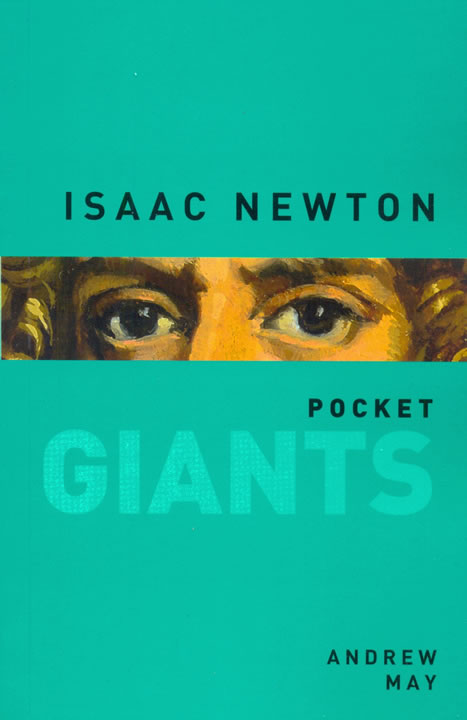
Win a copy of POCKET GIANTS: ISAAC NEWTON by Andrew May

isaac-newton-pocket-giantsThis competition is now closed.

The first two sets of correct answers to the competition questions were received from:

James Fulton of Wootton Wawen, Warwickshire.
Victoria Bennett of Horbury, West Riding of Yorkshire.


Each of the winners will receive a copy of Isaac Newton – Pocket Giants.


The questions, together with the answers, are as follows:

1 – What were the forenames of Isaac Newton’s parents?
a: Isaac and Hannah

2 – What relation was the Rev William Ayscough to Isaac Newton?
a: Uncle

3 – In what year did Isaac Newton take up his post as Warden of the Royal Mint?
a: 1696

4 – On what precise date, and where, was Isaac Newton buried?
a: 4th April 1727 in Westminster Abbey


Prizes donated by The History Press, publishers of the Pocket Giants series. Further details of the Pocket Giant books can be found here

Leave a Comment

Filed under Uncategorized

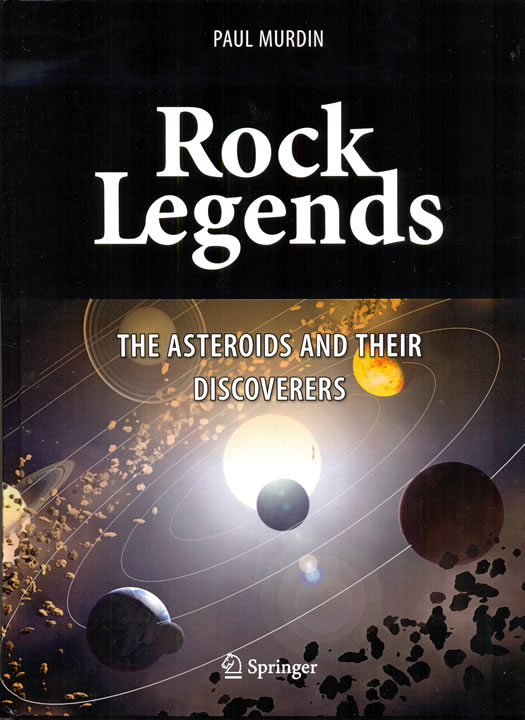
ROCK LEGENDS: THE ASTEROIDS AND THEIR DISCOVERERS by Paul Murdin

rock-legendsThis book relates the history of asteroid discoveries and christenings, from those of the early pioneering giants of Herschel and Piazzi to modern-day amateurs. Moving from history and anecdotal information to science, the book’s structure is provided by the names of the asteroids, including one named after the author.

Free from a need to conform to scientific naming conventions, the names evidence hero-worship, sycophancy, avarice, vanity, whimsy, erudition and wit, revealing the human side of astronomers, especially where controversy has followed the christening. Murdin draws from extensive historical records to explore the debate over these names. Each age reveals its own biases and preferences in the naming process.

Originally regarded as ‘vermin of the skies’, asteroids are minor planets, rocky scraps left over from the formation of the larger planets, or broken fragments of worlds that have collided. Their scientific classification as ‘minor’ planets makes them seem unimportant, but over the past decades asteroids have been acknowledged to be key players in the Solar System. This view of their starring role even alters the trajectories of spacecraft: NASA’s policy for new space missions en route to the outer planets is that they must divert to study passing asteroids whenever possible. This book provides for readers a complete tour of the fascinating world of asteroids.

You can purchase a copy of the book by CLICKING HERE.

Leave a Comment

Filed under Uncategorized

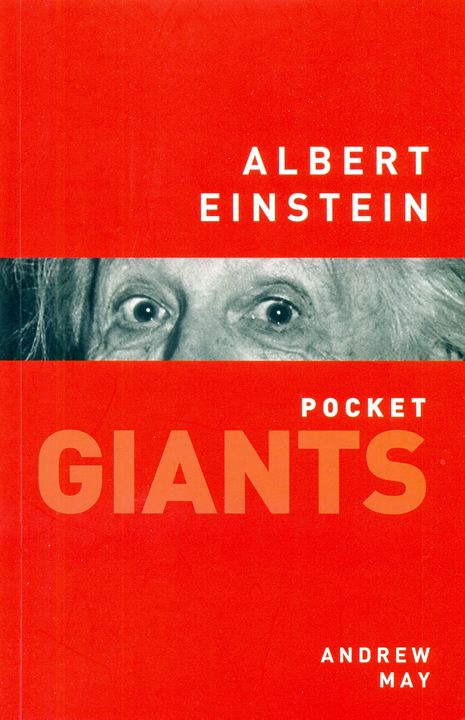
Win a copy of POCKET GIANTS: ALBERT EINSTEIN by Andrew May

Albert Einstein - Pocket GiantsThis competition is now closed.

The first two sets of correct answers to the competition questions were received from:

Rod Hine of Bradford, West Riding of Yorkshire.
Nick Evetts of Kempston, Bedfordshire.


Each of the winners will receive a copy of Albert Einstein – Pocket Giants.


The questions, together with the answers, are as follows:

1 – What school did Einstein enter at the age of 16, and where was the school situated?
a: Argovian Cantonal School in Aarau, Switzerland.

2 – In what year did Einstein pay his first visit to the United States of America?
a: 1921

3 – In what month and year did Einstein’s second wife Elsa die?
a: December 1936

4 – In what year was Einstein offered the presidency of Israel?
a: 1952


Prizes donated by The History Press, publishers of the Pocket Giants series. Further details of the Pocket Giant books can be found here

Leave a Comment

Filed under Uncategorized

UNCHARTED CONSTELLATIONS by John C. Barentine

uncharted_constellationsThis book compiles an array of interesting constellations that fell by the wayside before the International Astronomical Union established the modern canon of constellations, a decision that left out lesser known ones. Their history is nevertheless interesting, and at last author John Barentine is giving them their due. This book is a companion to The Lost Constellations, highlighting the more obscure configurations.

Extensively illustrated with figures drawn from classic works of celestial cartography which appeared during the period from the 17th to the 19th century, the 16 constellations found in this volume fall into one or more of three broad categories: asterisms, such as the Big Dipper in Ursa Major; single-sourced constellations introduced on surviving charts by a cartographer perhaps currying the favour of sponsors; and re-brands, new figures meant to displace existing constellations, often for an ideological reason. All of them reveal something unique about the development of humanity’s map of the sky.

You can purchase a copy of Uncharted Constellations by CLICKING HERE.

Leave a Comment

Filed under Uncategorized

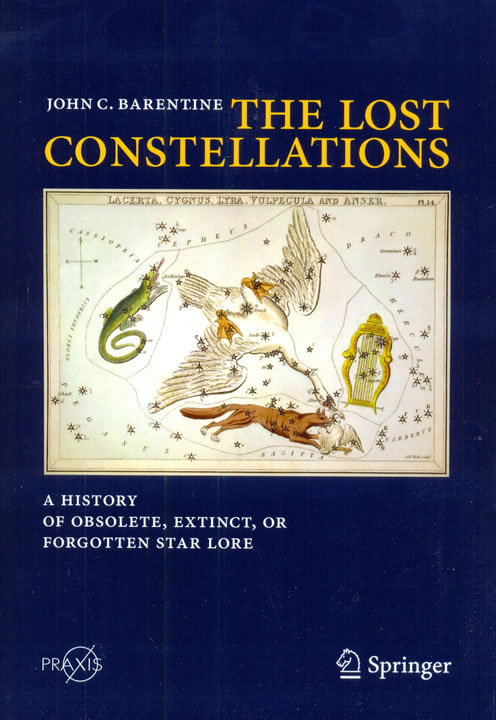
THE LOST CONSTELLATIONS by John C. Barentine

The Lost Constellations-1Casual stargazers are familiar with many classical figures and asterisms composed of bright stars, such as Boötes, Crux, Orion and the Plough, although this book reveals not just the constellations of today but also those of yesteryear. The history of the human identification of constellations among the stars is explored through the stories of some influential celestial cartographers whose works determined whether new inventions survived.

The history of how the modern set of 88 constellations was defined by the professional astronomy community is recounted, explaining how the constellations described in the book became permanently ‘extinct’.

Dr. Barentine addresses why some figures were tried and discarded, and also directs observers to how those figures can still be picked out on a clear night. These lost constellations are described in great detail using historical references, enabling observers to rediscover them on their own surveys of the sky. This book, together with the companion volume Uncharted Constellations, offers an array of interesting and intriguing star groups which, although they effectively vanished from star charts when the International Astronomical Union laid down the modern list of constellations almost a century ago, are still there if we know where to look.

Treatment and recognition of the obsolete constellations as extant features of the celestial sphere adds a new dimension to stargazing that merges history with the accessibility and immediacy of the night sky.

You can purchase a copy of The Lost Constellations by CLICKING HERE.

Leave a Comment

Filed under Uncategorized

GALAXY: MAPPING THE COSMOS
by James Geach

Galaxy (James Geach)This book is a compelling tour of the state-of-the-art science of extragalactic astronomy. It offers a first-hand account of both the science itself and how it is done, describing what we currently know as well as what we don’t. Astronomer James Geach takes us back 100 years to when scientists first proved the existence of other, distant galaxies, and tracks the continued improvement in our ability to collect and interpret the light emitted by faraway galaxies. He discusses examples of our rapidly accelerating research, from the initial discovery that faint ‘spiral nebulae’ were actually separate star systems located far beyond the Milky Way to the latest observations of the nature of extremely distant galaxies and how they have evolved. He also examines the theoretical framework and computer simulations that describe our current ‘world model’ of the universe.

The numbers involved when it comes to discussing stars, galaxies and the inconceivably vast tracts of empty space between them are staggering. With hundreds of billions of galaxies in the observable universe, all of varying shapes, sizes and ages – each containing hundreds of billions of suns – at first glance our universe appears frustratingly unknowable, and yet it is captivating to explore.

With over one hundred superb colour illustrations, GALAXY: MAPPING THE COSMOS is an illuminating guide to the choreography of the cosmos, chronicling how our home in the universe came to be and how we came to know our place within it.

‘An enthralling, detailed and beautiful look at one of the most challenging and exciting areas of modern astronomy, and a great addition to any enthusiast’s library.’  Sky at Night Magazine

Starlight Nights readers can receive a special 20% discount by ordering online and entering the code ‘SN-20’ at the checkout. This offer expires 31 July 2016.

You can purchase a copy of the book by CLICKING HERE.

Leave a Comment

Filed under Uncategorized

WHAT STAR? by Brian Jones

The constellations are arbitrary groupings of stars which form patterns or imaginary pictures in the night sky. There are 88 official constellations which together cover the entire sky, many of these having traditional names and associations with folklore and mythology. What Star? identifies and describes each of the constellations, providing useful information as to its location, form and mythology.

What StarThis highly illustrated book takes the reader on an exciting and informative journey of discovery around the sky at night. Aimed at both the beginner and the more accomplished star gazer, the main part of the book comprises an alphabetical section covering the 88 star patterns that adorn our night sky, some familiar and others perhaps less so.

Since ancient times the night sky, with all its sparkling beauty, has been a source of fascination to mankind. Although a number of the constellations that grace modern star charts were devised in relatively recent times, many were created by the astronomers and story-tellers of old, both to honour the characters in their mythology and also to create a framework of reference in the heavens and to bring a sense of order to the confusion of stars that shone down upon them.

Orion-highThe information given for each constellation includes a coloured chart (such as the one shown here) together with an outline of myths and legends attached to each group and information relating to the individual stars that form it, including their brightness, distance and colour. We also take a look at some of the deep sky objects that are found within each constellation, such as double stars, variable stars, star clusters, nebulae and galaxies, with information to help you track these objects down.

What Star? also includes a useful introductory section together with charts showing the whole sky for each season and an illustrated Glossary explaining the terms used within the main body of the book. Featuring over 100 of the best photographs ever captured of the night sky, this book will prove to be a handy work of reference for the beginner and more experienced observer alike.

What Star? will show that you don’t need an expensive telescope or elaborate equipment to enjoy the night sky and that, armed with little more than a pair of binoculars or a small telescope, you can commence your journey around the night sky.

You can purchase your copy of What Star? by CLICKING HERE

Happy stargazing!

Leave a Comment

Filed under Uncategorized

POCKET SKY ATLAS – Jumbo Edition by Roger W. Sinnott

Sky and Telescope’s celestial atlases are the standard by which all other star atlases have been judged for a half century. Now we’ve raised the bar again with our Pocket Sky Atlas – Jumbo Edition. There has never been such a wonderfully detailed atlas so handy to take on trips and use at the telescope, thanks to its user-friendly size, convenient spiral-bound design, and easy-to-read labels. The charts show both constellation boundaries and stick figures to help you find your way.

Pocket Sky AtlasAs the preface points out, the backyard astronomer of today has access to a wide range of star atlases and it is often difficult to choose which one is right for you. Many of those which are currently available are large and unwieldy and are perhaps more suited for reference at home. What the travelling observer needs, in his or her desire to escape light pollution, is a portable and easy-to-use sky guide, and the Pocket Sky Atlas certainly seems to fit the bill.

This atlas is small and portable, measuring around 12 inches (30cm) x 9 inches (22cm), and is probably too big for most pockets. However, it is perfect for the average backpack or car glove box and, because of the spiral binding, is easy to hold while observing, either flat or folded back on itself. Although relatively small and inexpensive, the Pocket Sky Atlas is well thought out and organised. Printed on heavy paper with a smooth, glare-free finish, and containing charts which collectively cover the entire sky, the book opens with a brief but well-written introduction by Roger W. Sinnott which explains the layout of the atlas and the information it contains. From a personal point of view, one of its attributes is the fact that, along with the constellation boundaries being depicted, the main stars within each constellation are joined to form the traditional ‘stick figures’ that make both the identification of each group, and the way it sits against the backdrop of the sky as a whole, that much more straightforward. The generous amount of overlap between adjacent charts makes star hopping across individual chart boundaries easier.

The list of objects contained on the charts is impressive. Showing over 30,000 stars down to visual magnitude 7.6 the atlas also depicts a large number of deep sky objects including many double and multiple stars; variable stars with minimum of magnitude 7.6 or brighter; globular clusters down to magnitude 10.5; galaxies to magnitude 11.5; planetary nebulae to around magnitude 12; and open clusters whose overall brightness exceeds that of an 8th magnitude star. In addition there are many bright and dark nebulae, together with all the objects in both the Herschel 400 observing list and Messier Catalogue. The Messier objects are identified by their M numbers rather than NGC numbers, although those from Patrick Moore’s popular Caldwell catalogue are identified by their NGC numbers rather than their Caldwell numbers. For both the Messier and the Caldwell objects, there are lists in the back of the atlas which cross-reference the Messier or Caldwell numbers with their corresponding NGC numbers, as well as identifying the specific chart(s) on which they can be located.

In addition to the main charts, there are a ten ‘close-up charts’ showing in greater detail the regions around the Pleiades; Orion’s Sword; the Virgo Galaxy Cluster; the Large Magellanic Cloud; the Cone and Rosette nebulae in Monoceros; fields of galaxies in Ursa Major and Leo; the North American Nebula near Deneb in Cygnus; and the rich stars fields in Sagittarius and Scorpius.

The symbols used for different types of deep sky object are clear and are generally to scale and show orientation, which can be a great help. All symbols are depicted on the Chart Legend which is repeated at regular intervals throughout the atlas.

The fact that this atlas was designed by experienced observers is obvious. As a portable, concise and easy-to-use observing guide, this one is hard to beat and fits well into the range of atlases currently available for both the backyard astronomer and the rural star gazer.

You can purchase a copy of Pocket Sky Atlas – Jumbo Edition by CLICKING HERE.
Leave a Comment

Filed under Uncategorized